Clinical evaluation.
Thorough psychiatric evaluation in-person or via telehealth. Anna reviews your treatment history, symptoms, conditions, and medications. If ketamine isn't appropriate, she'll tell you that and discuss alternatives.
Medically supervised ketamine sessions for adults with treatment-resistant depression, PTSD, and severe anxiety. Evaluated, administered, and monitored from start to finish by Anna Stouffer, PMHNP at our Wesley Chapel clinic. FDA-approved Spravato (esketamine) nasal spray also available.
For when standard care hasn't worked.
You've probably already done the research. You've read about response rates, looked up clinics, and weighed whether the cost is worth it. If you've tried two or more antidepressants without adequate relief and you're still struggling, ketamine therapy is a treatment option worth discussing with a provider who knows the evidence and will be straight with you about what it can and can't do.
Ketamine is a Schedule III controlled substance administered only under medical supervision. Off-label use for depression, PTSD, anxiety, and pain. Individual responses vary — there is no guarantee of response.
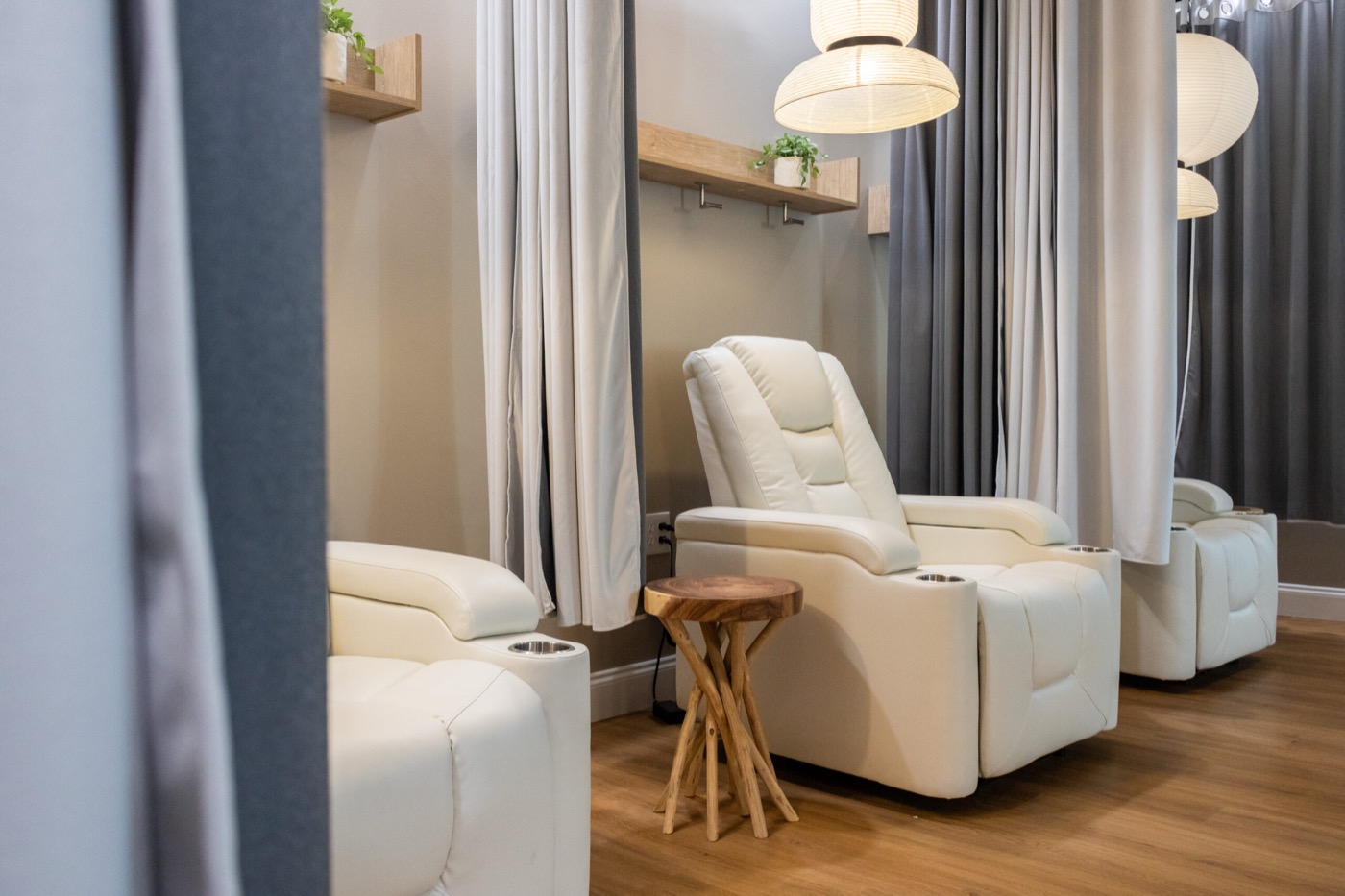
Real treatment room · Wesley Chapel
Ketamine therapy at Ascend begins with a full psychiatric evaluation — no exceptions. Before any treatment is scheduled, your provider reviews your diagnostic history, prior medication trials, and clinical trajectory. The evaluation determines whether ketamine is appropriate for you — and if it isn't, you'll hear that clearly, along with alternatives worth exploring.
This is not a high-volume infusion model. Ascend doesn't run a prescription-to-drip pipeline. Every patient is assessed individually against the clinical evidence base, and the bar is genuinely high — you must have tried and not adequately responded to at least two prior medication approaches before ketamine is considered.
Because ketamine treatment at Ascend is integrated with our psychiatry practice, your provider can coordinate directly if your broader psychiatric plan needs adjustment — no external referral required.
There is no shortcut. The evidence supports a structured induction series followed by maintenance based on individual response.
Thorough psychiatric evaluation in-person or via telehealth. Anna reviews your treatment history, symptoms, conditions, and medications. If ketamine isn't appropriate, she'll tell you that and discuss alternatives.
6 sessions over 2–3 weeks. Each session is ~90 minutes total: 10–15 min check, 40–60 min administration in a recliner, 20–30 min recovery observation. You'll need a ride home.
After induction, Anna evaluates your response and sets a maintenance schedule. Some patients come monthly. Others every 6–8 weeks. It depends entirely on how you respond.
The clinical bar is high. You must have tried — and not adequately responded to — at least two medication trials. Anna reviews each case individually against the evidence and will be honest about whether ketamine makes sense for your situation.
The primary indication. Defined as failure to respond adequately to two or more antidepressant medications at therapeutic doses. This is the condition with the strongest evidence base for ketamine treatment.
Learn MoreWhen standard treatments — including trauma-focused therapy and first-line medications — have not produced sufficient relief. Ketamine for PTSD is used off-label. Not appropriate as a first-line treatment.
Learn MoreTreatment-resistant anxiety that hasn't responded to standard pharmacological and therapeutic approaches. Evaluated case by case — not all anxiety presentations are appropriate candidates for ketamine.
Learn MoreConditions such as CRPS and neuropathic pain evaluated individually. Ketamine for pain is used off-label — case-by-case evaluation required. Clinical appropriateness is determined during your psychiatric evaluation with Anna.
Learn MoreThe FDA-approved nasal spray specifically indicated for treatment-resistant depression. Unlike infused ketamine, Spravato may be partially covered by insurance for qualifying patients. Available at our Wesley Chapel clinic.
Spravato vs. KetamineWhen major depressive disorder has not improved through sequential antidepressant trials, ketamine may be evaluated as an adjunctive option — coordinated with your broader psychiatric and primary care plan at Ascend.
Learn More Ketamine Lead · Wesley Chapel
MS · FNP · Dual-Board-Certified · 10+ Years Clinical
"Every ketamine patient goes through a real evaluation first. I review your full psychiatric and medication history — and I'm honest about whether this treatment makes sense for you. If it doesn't, I'll tell you directly. And we'll talk about what does."
[NEEDED: verified patient quote — collect from a public review platform or direct patient written consent before launch. Ketamine testimonials should not reference specific diagnoses per HIPAA/FTC guidance.]
Ketamine therapy is a self-pay service at most practices, including ours. Spravato (esketamine) may be partially covered by insurance for treatment-resistant depression — call us to verify your benefits.
Financing available: CareCredit, Cherry, and Advance Care Card. Ask when you schedule your consultation.
Off-label use: Racemic ketamine is used off-label for depression, PTSD, anxiety, and pain. It is not FDA-approved for these uses.
FDA-approved option: Spravato (esketamine) is the FDA-approved nasal spray specifically indicated for treatment-resistant depression.
Controlled substance: Ketamine is a Schedule III controlled substance and is administered only under medical supervision at our Wesley Chapel clinic.
Individual responses vary: Clinical studies suggest ketamine may produce improvement in depressive symptoms in some patients. Not all patients respond. There is no guarantee of response.
Near SR 54 and Meadow Pointe Boulevard, ~2 minutes from the Shops at Wiregrass. Free parking. Ground-floor suite. Treatment rooms are private, quiet, and designed for comfort during longer sessions.
Most patients describe the experience during the session as a dreamlike or dissociative state. Some feel a sense of floating or detachment. Others experience mild visual changes. Nausea and dizziness are common but usually manageable. The effects wear off within 1 to 2 hours after the session. You'll be monitored the entire time and won't be left alone.
Some patients report changes in mood or outlook after the first few sessions. Others need the full induction series before noticing meaningful shifts. There's no guarantee of response, and Anna will check in with you after every session to assess how things are tracking.
Ketamine has potential for misuse, which is why it's classified as a Schedule III controlled substance. In a supervised clinical setting with medical monitoring and structured dosing, the risk is managed. Anna screens for substance use history during the evaluation and monitors patients throughout treatment.
Racemic ketamine is used off-label for depression, PTSD, anxiety, and pain. It is not FDA-approved for these indications. Spravato (esketamine) is the FDA-approved nasal spray specifically indicated for treatment-resistant depression. Both are available at Ascend.
Missing one session usually doesn't derail the series, but gaps can reduce effectiveness. If you need to reschedule, call as soon as possible so the clinical team can adjust your protocol. Consistency matters most during the induction phase.
You'll receive specific instructions before your first session. Generally, patients are asked to avoid heavy meals for a few hours before treatment to reduce the chance of nausea. Light snacks are usually fine. No alcohol or recreational substances for at least 24 hours before.
Schedule a consultation with Anna Stouffer, PMHNP. She'll review your history, answer your questions, and give you a straight answer about whether ketamine makes sense for your situation. Results vary — there is no guarantee of response.
Ketamine is a Schedule III controlled substance administered only under medical supervision. Off-label use for depression, PTSD, anxiety.